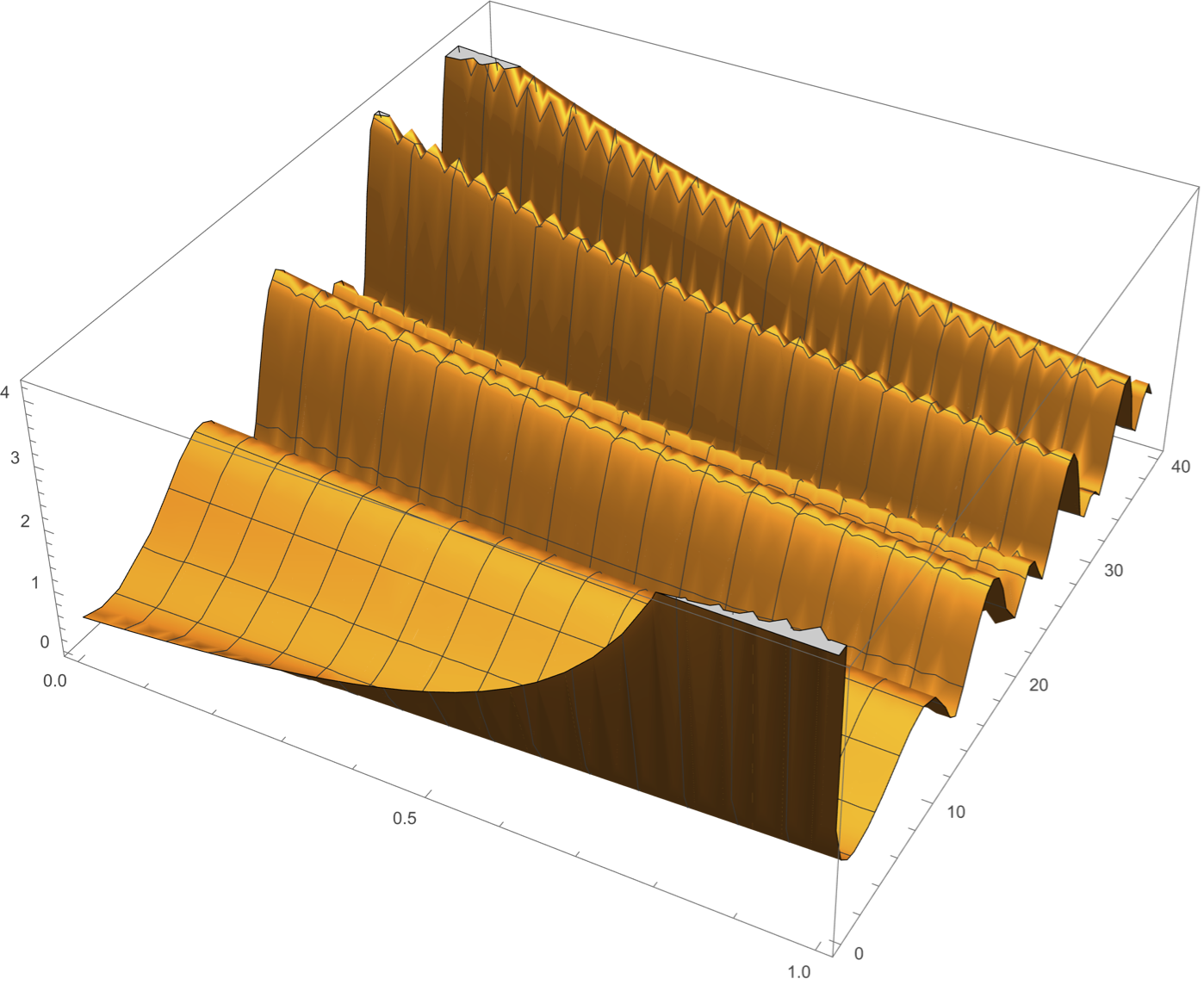
The absolute value of the Zeta function. with the real axis angling towards the upper left and the imaginary axis angling towards upper right; plot produced by Mathematica
The announcement
Mathematicians awoke today (20 Nov 2026) to a startling announcement: Levent Alpöge, a mathematician at the AI firm Anthropic, claimed to have proven, with the assistance of a recent version of Anthropic’s Claude, the most famous unsolved problem in all of mathematics, namely the Riemann Hypothesis. As Alpöge explains on his website:
“I believe I have, working with Claude, discovered a proof of the Riemann Hypothesis. In fact, the method easily extends much further, resolving the so-called Generalized Riemann Hypothesis, and I expect, with more time, the Extended Riemann Hypothesis too. Claude and I have also formalized the arguments without assumptions. It is natural to feel that this is an end, in my case a loss of a principal guiding light, but what I saw during the course of progress so amazed me that I believe it is one dawn across science of something far greater.”
What does this mean? First of all, it must be understood clearly that Alpöge has NOT published a full human-comprehensible proof, much less a fully certified, peer-reviewed proof as is the normal custom in the field of mathematics. Instead he has provided a link to a “proof” (over 17 million lines of code) produced by Claude in the format of the proof-checking software Lean, which has certified that it is correct. Several other mathematicians, contacted today, have reported independently verifying the result using Lean. There is some possibility that Lean could mistakenly certify the proof as correct, but this is not considered likely at this point.
As emphasized above, there is as yet no writeup that humans can understand. Over the next few months (or years?) mathematicians intently study this “proof” with the goal of translating the arguments into conventional mathematical language. Hopefully at some point, researchers will be able produce an exposition that can be followed by other professionally trained mathematicians, although it very likely will be a very long work, probably not thoroughly understood by any single mathematician, with numerous teams of mathematicians analyzing separate parts.
Background on the Riemann Hypothesis
So what is the Riemann Hypothesis? It is an assertion about the behavior of the zeta function, which is given by the formula
$$\zeta(s) = \sum_{n=1}^\infty \frac{1}{n^s} = \frac{1}{1^s} + \frac{1}{2^s} + \frac{1}{3^s} \cdots,$$
considered as a function of a complex variable $s$. Although it is difficult to fully visualize zeta as a complex function, the graphic in the upper right corner plots the absolute value of $\zeta(s)$, where the real part of $s$ angles to the upper left, and the imaginary part of $s$ angles to the upper right.
In particular, the assertion of the Riemann Hypothesis is that except for some “trivial” zeroes at even negative integers, the only zeroes of $\zeta(s)$ are for $s$ whose real part is $1/2$. In other words, $\zeta(s) = 0$ only for $s = -2, -4, \cdots,$ and other $s$ with ${\rm Re}(s) = 1/2$. The Generalized Riemann Hypothesis says the same about certain global $L$ functions: see here for more details.
So why do mathematicians care about the Riemann Hypothesis? As it turns out, it encodes countless secrets about the distribution of prime numbers and numerous other phenomena in the mathematical universe. It has widely been regarded as the most important unsolved problem of mathematics, for over 100 years. Its (apparent) proof by an artificial intelligent model marks an emphatic end to the enormous advance of these models during the past year, which has convulsed the mathematical community.
Cornell mathematician Steven Strogatz described today’s event as “If it turns out to be correct, it will be a memorable moment [in mathematics].” Alex Kontorovich of Rutgers University, who expressed his stock at an earlier AI-assisted proof of a much weaker “quasi-Riemann Hypothesis,” was flabbergasted with today’s announcement, saying, “I’m absolutely, absolutely shocked.”
Reactions
Some mathematicians are deeply grieving over the “death” of their field, at least as the exclusive province of human mathematicians: “Mathematics will never be the same.” Scott Aaronson of the University of Texas, Austin, for one, lamented, “Human mathematicians are forevermore dethroned as the main theorem-proving entities on planet earth.” Prominent mathematician Ken Ono warned math students at U.C. Berkeley that “You might be graduating into a profession that might not even exist, or that will be very different than what you expected. … You need to brace.”
With a somewhat more hopeful outlook, Carlo Pagano of Concordia University, currently visiting at Google DeepMind, commented, “If true, even from a first high level scan of the summary of the proposed argument, it is very plausible to me that the new ideas in the proof will open up brand new avenues of thinking in number theory and have an immense impact beside the obviously extremely influential result in itself.”
Andrew Sutherland of MIT, opined, “This is indeed an historic moment. … The world has changed. … I know there will be a wide range of reactions in our community, but to me this is a human triumph, and a day for celebration.”
UCLA’s Terence Tao, arguably the world’s most acclaimed mathematician, previously offered this hope:
[Students and researchers] will have to use their imagination. … This is a time for creativity, and I do hope [they] rise to the challenge. They didn’t ask for it. But I think many of them will surprise us.
We will see. But one way or the other, it is unlikely that any mathematician will ever forget this historic date.
Additional details and commentary:
Economist; New York Times; Scientific American; Washington Post.