The march of human progress
There is much to celebrate in modern society: Crime rates are declining worldwide; worldwide extreme poverty continues to fall; worldwide life expectancy continues to rise; computer and information technologies continue their remarkable forward march; artificial intelligence is on the rise, which, while carrying some risks, also holds great promise; and advances in science and medicine continue on many fronts, far too numerous to list. See this previous Math Scholar article for more details.
A crisis in education
However, there is one arena of concern in today’s society that certainly deserves more attention: the education crisis. Here are just a few of the numerous recent reports that could be listed:
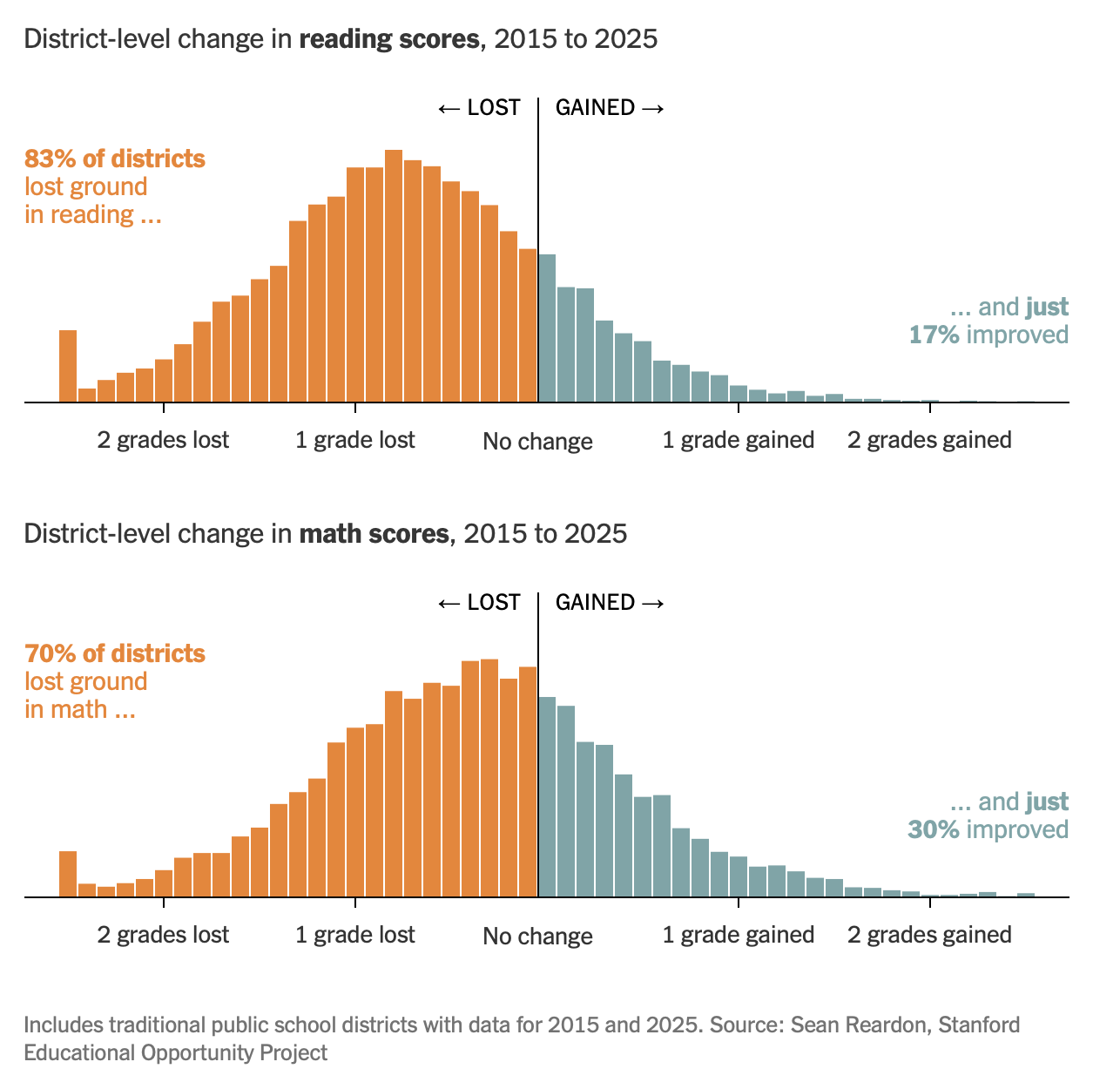
- U.S. educational test scores are in a generation-long decline: from 2015 to 2025, 83% of school districts lost ground in reading, and 70% of districts lost ground in mathematics (see graph on right).
- Twelfth-grade U.S. reading scores have dropped to the lowest level since 2005. Sadly, the declines have been greatest for those students from lower socioeconomic environments.
- A working group at the University of California, San Diego found that 900 of the latest incoming freshman class had mathematics skills below high-school level, and most of those did not even fully meet middle-school standards. Nationwide, college professors teaching mathematics and computer science courses report growing numbers of incoming students unable to do basic algebra or solve simple word problems.
- Led by Mina Aganagic of the U.C. Berkeley mathematics department, 2100 faculty from the University of California system have signed an open letter demanding that standardized tests be required again for admission applicants in STEM fields. A similar letter demanding standardized tests in non-STEM fields now has over 800 signatures.
- Similar declines are seen in other fields. Even at elite U.S. universities, professors report difficulties getting students to engage with full-length literature texts; in many cases students have never read such “lengthy” works and are flummoxed by them.
- Along this line, many film-studies professors report difficulties getting students, accustomed to a diet of short TikTok videos, to watch full-length movies.
- Grade inflation is rampant at all levels. At Harvard University, the percentage of A grades soared from 24% of all grades in 2005 to 60% in 2025. Harvard professors have now agreed to impose a hard limit on the number of A grades that can be handed out in each course.
- Outside the U.S., the situation is somewhat better, but still of considerable concern. The latest data from the OECD on its “Survey of Adult Skills” found that the share of tertiary (college-level) students performing at or below its lowest level ranged from 4.5% in Germany (literacy) and 5% in Singapore (numeracy) to 20% in Poland (literacy) and 19% in Italy (numeracy). Across all OECD nations, an average 8% of college-level students have a literacy score no better than one might expect from a 10-year-old child.
Some have claimed that with the rise of artificial intelligence, rigorous education will no longer be necessary. But the consensus of those who have examined the issue to date finds quite the opposite conclusion: those who will be most successful in the utilization of AI (e.g., recognizing problems that can be solved; formulating them for AI; interpreting and applying the results) will be those who are both well-grounded in mathematics and computing and also have a broad understanding of the humanities and the sophisticated workings of a modern society.
The dumbing down of society
These concerns do not end with the educational system. An increasing percentage of the public entertains pseudocientific beliefs such as lucky numbers, extrasensory perception, magnetic therapy, and astrology — yes astrology, the absurd and utterly unscientific notion that one’s future is keyed to the positions of various planets and stars in the sky at the moment of one’s birth (in an enclosed room of a hospital!). A 2016 study found that 37% of the U.S. public assert that astrology was “very scientific” or “sort of scientific,” percentages that are higher than in 2004.
Along this line, offerings of pseudoscientific “wellness” regimes and products have exploded in popularity. As a single example, the Goop line, promoted by Hollywood actress Gwyneth Paltrow, has sold stickers, which, when affixed to one’s skin, supposedly rebalance the energy frequency in our bodies. More importantly, millions of parents are refusing permission for their children to be vaccinated, believing anti-vaccination propaganda over well-established, peer-reviewed science. In 2024-25, the percentage of U.S. kindergarten students who had received measles vaccination had declined to 92.5%, with significantly lower figures in certain localities, resulting in several outbreaks of the disease. In a similar vein, 58% of U.S. consumers report making purchases based on the recommendations of “influencers,” who in most cases are utterly unqualified to make such endorsements.
Who (or what) is to blame?
These reports have launched multiple rounds of finger pointing, with various parties (teachers, parents, curriculum writers, university academics, scientists, politicians) being blamed. However, the timing (mid-2010s) of the onset of the U.S. decline suggests three principal factors: (a) the ending of most federal school accountability programs; (b) the rise of smartphones and social media; and (c) rising student absenteeism.
With regards to smartphones and social media, researchers have found that usage of social media and chatbots is associated with lower cognitive performance — “brain rot” in modern parlance. For example, a study led by a U.C. San Francisco researcher followed more than 6500 young people aged 9 to 13 over a two-year period. Test results found that youth who reported using social media 1-3 hours per day scored significantly lower on reading, memory and vocabulary tests, compared with those who did not use social media.
In the wake of these findings, some nations and states are seriously considering enacting bans on social media for young people. Australia, the U.K., Turkey and Indonesia have already enacted a ban of platforms such as TikTok, YouTube and Instagram for youth under a certain age (typically 15 or 16).
What can be done?
Just as the latest assessment tests have highlighted the problem, they may also be highlighting the solution. In the U.S., notable exceptions to the otherwise depressing declines of test scores are three relatively less-wealthy Southern states:
- Lousiana ranks #1 in the nation in recovery from pandemic-era losses in reading.
- Alabama ranks #1 in recovery of mathematics scores; it is also now the state with the lowest chronic absenteeism rate.
- Once an educational disaster area, Mississippi now ranks #9 in the nation in fourth grade reading; after adjusting for demographics such as poverty and race, it ranks #1. With the same adjustment, Mississippi also ranks #1 in fourth grade and eighth grade mathematics. Mississippi’s striking success has been termed the “Mississippi miracle.”
It is particularly remarkable that these Southern states have raised student achievement with very modest budgets: $12,000 per pupil in Alabama and Mississippi in 2024, compared with $30,000 in New York.
Common threads in these states include strong educational leadership, coherent statewide strategies (such as “science of reading” curricula with emphasis on phonics), teacher coaching, measurement of student performance, and accountability of individual schools and districts. These no-nonsense strategies compare with states such as Oregon, which for a time reduced graduation requirements, and cities such as San Francisco, which for a time stopped teaching algebra to eighth graders.
Interestingly, poor nations of sub-Saharan Africa also appear to be leading the way internationally. According to UNESCO, since 2000, sub-Saharan Africa has more than doubled the number of students enrolled in primary schools, and more than tripled the enrollment in secondary schools; completion rates have also increased.
Unfortunately, the outlook for lasting change is mixed, at least in the U.S., since following the lead of states such as Louisiana, Alabama and Mississippi will not be easy. Traditionally “red” states may be unwilling to make these changes, out of general ambivalence towards public education. And traditionally “blue” states, which have long relied on the support of large labor organizations, may be reluctant to ask teacher unions for reforms. So while change is possible, it will not come easily or cheaply.
In any event, the stakes are high. As Stanford mathematics professor Brian Conrad explains:
Who is going to trust somebody who got a degree in airline engineering who doesn’t know how to think through a problem without a computer telling them the answer? … The premise that foundational ideas don’t need to be learned anymore is a recipe for idiocracy.