Source: New York Times
A discouraging year
Today, as a year ago when we posted a similar report, there is no shortage of discouraging news headlines, among them (as of 1 Jan 2026):
- A war in Ukraine that has continued for nearly four years, killing or injuring hundreds of thousands on each side.
- A war in Gaza that, despite a shaky cease-fire, raises serious questions about the long-term stability of the Middle East.
- Simmering conflicts in Afghanistan, Colombia, Haiti, Iran, Myanmar, Nigeria, Somalia, Sudan, Venezuela and Yemen.
- A never-ending stream of earthquakes, floods, hurricanes and wildfires.
- Political disagreements which, no matter which side one might prefer, are significantly more nasty and prone to violence than in the past.
- Worries about artificial intelligence.
- Frustration over continuing public resistance to addressing climate change, green energy and endangered species.
- Frustration over the persistence of sexism, racism, xenophobia, Islamophobia and anti-Semitism.
- Frustration over the persistence of discredited pseudoscientific conspiracy theories (e.g., that the Apollo moon landings were faked, or that common vaccines cause autism).
These are serious problems and must be addressed. On the other hand, we have to wonder whether the public’s insatiable appetite for sensational bad news, and the press’ willingness to focus on such news, is seriously obscuring the broader picture of human progress. To that end, we present here a few items of good news that deserve significantly more attention.
Science and technology advances
To begin with, many fields of science and technology continue to advance with unstoppable momentum, in spite of governmental budget cuts and public opposition from some quarters. Part of the credit for this progress is rooted in Moore’s Law, which continues unabated after more than 50 years: Just in the 20 years since 2005, aggregate memory and computer power of comparable devices have increased by factors of roughly 1,000,000. Today a typical new smartphone has memory and computing power comparable to that of a 2000-era supercomputer. Genome sequencing, for instance, has advanced even faster — sequencing a full human genome cost $3 billion in 2003, but currently costs only about $300, a 10,000,000-fold reduction. See the listings below for many other notable items of recent progress.
Crime declines
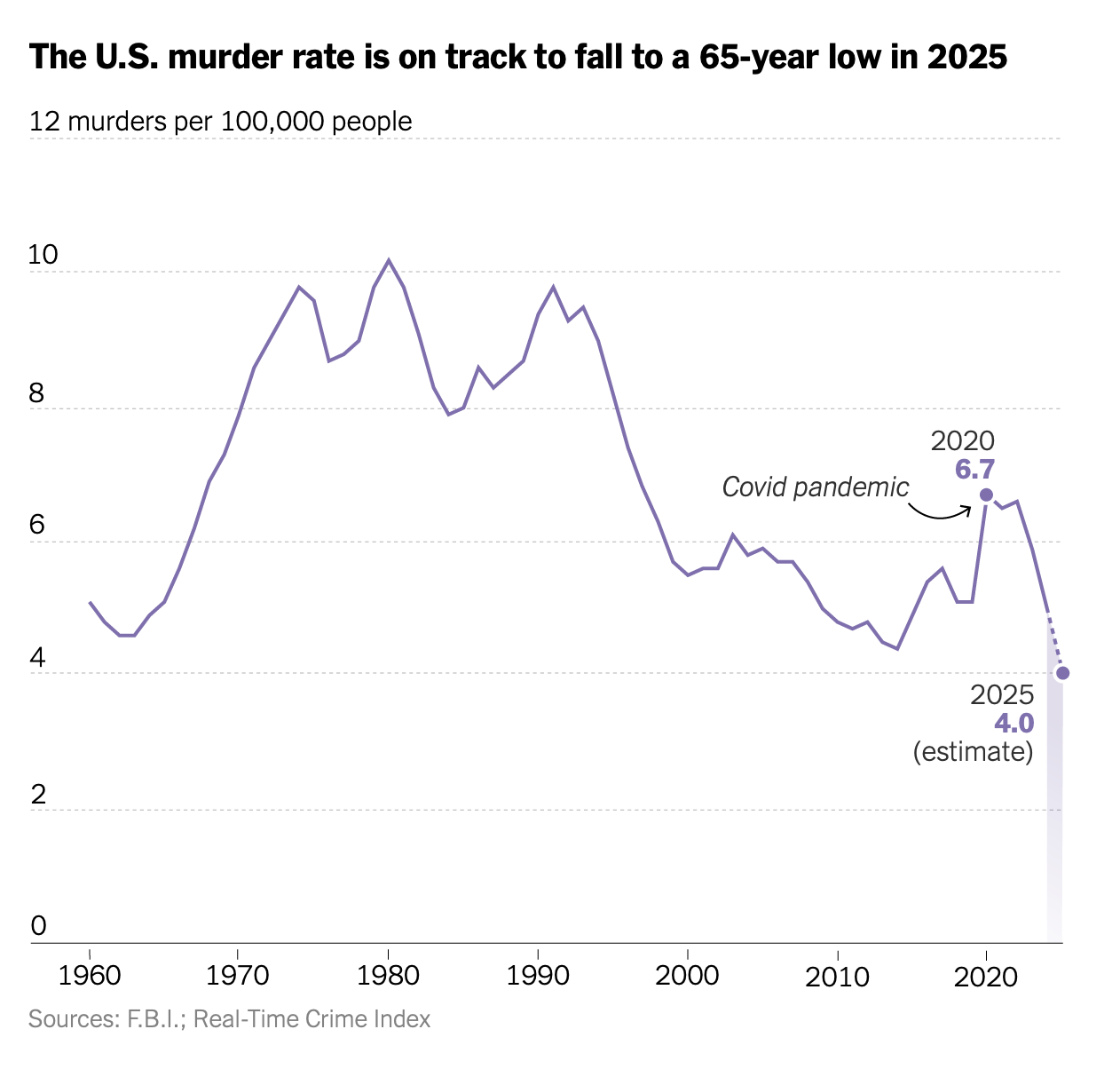
Contrary to almost universal misperception, crime rates in most cities worldwide have fallen over the past several years. These declines have been particularly dramatic in the U.S. For example, after rising somewhat during the Covid-19 pandemic, the U.S. homicide rate fell 11.6% in 2023 from 2022, which was at the time the largest one-year percentage decline in history, then fell another 14.9% in 2024, which again broke a record, and is likely to drop an additional 19.8% for 2025, which again will smash records and likely achieve a 65-year low (see graph above). Several large U.S. cities have seen particularly large drops: 61% fewer homicides in Baltimore in 2025, compared with 2021; 50% fewer in Philadelphia; 49% fewer in Chicago; 48% fewer in Indianapolis; 30% fewer in Los Angeles. Other U.S. crime statistics are similarly down; for example, U.S. auto thefts have fallen by 39% from 2020 through 2025.
Similar declines, if not as dramatic, have been seen in other nations as well. In the first six months of 2025, the crime rate in England and Wales dropped to an all-time low, fully 75% lower than in 1995. In Australia, youth crime rates have also dropped to record lows. See also “Crime” below.
Global poverty, life expectancy and education
Just as importantly, global poverty continues a remarkable long-running decline: Over the past 35 years, on average approximately 115,000 persons per day have escaped extreme poverty. This is not a misprint! Here “extreme poverty” is defined by the World Bank as an income less than $3 per day per person, adjusted for inflation (2021 U.S. dollars). As recently as 1820, 79% of the world population were in extreme poverty; this dropped to 52% by 1950, and is now only 9.9%. The U.N. has established a goal to eliminate extreme poverty worldwide by 2030, but achieving this goal is expected to be significantly more challenging than in the past. See also “Inequality, poverty, marriage and education” below.
Along this line, global life expectancy continues to increase. As of 2023 (the latest data available) the global figure is 73.2 years, with 77.3 years in the Americas and 79.1 years in Western Europe. By contrast, as late as 1870 the global figure was only 29.7 years, and as recently as 1950 was only 46.4 years. It is worth emphasizing that the current global figure (73.2 years) exceeds that of the wealthy nations of Western Europe and North America in 1970 (70.3 years). See also “Longevity and mortality” below.
One of the key factors here is the eradication of smallpox and rinderpest and the near-eradication of polio and guinea worm disease. Other diseases that may soon be eradicated include measles, mumps, rubella, lymphatic filariasis (elephantiasis), trypanosomiasis (sleeping sickness) and cysticercosis. The Gates Foundation hopes to end malaria by 2040. See also “Health and medicine” below.
In the same vein, worldwide education continues to advance. In 1820, only 18% of the world population had a formal basic education; in the latest survey, this has risen to over 90%. In 1820, there was a sizable gender gap in education; now virtually the same percentage of girls as boys are enrolled worldwide in primary education (89% vs 91%), and women outnumber men in college in several western nations, including the U.S. See also “Inequality, poverty, marriage and education” below.
Progress in 2025
As noted above, many serious challenges remain to restore peace, to address climate change and other environmental problems, and to eradicate hunger, poverty and social injustice. But we must not lose sight of the substantial progress that has been achieved. Here are just a few of the many items of progress worth celebrating during calendar year 2025. Numerous other interesting items are listed HERE and HERE, from which many of the items below were selected. Most of these links are to brief summaries; follow the links in the summaries for full reports.
Health and medicine
- The World Is Winning the War on Cancer.
- Cancer and Heart Disease Death Rates Have Declined in 150 Countries Since 2010.
- US Childhood Cancer Deaths Have Declined Six-Fold over Seventy Years.
- Rate of Cervical Precancers Plummeting in Young US Women.
- Childhood Leukemia: How a Deadly Cancer Became Treatable.
- US Approves “Milestone” Parkinson’s Treatment for 2025 Release.
- Strongest Evidence Yet That Shingles Vaccine Helps Cut Dementia Risk.
- People with Severe Diabetes Are Cured in Small Trial of New Drug.
- Cardiovascular Disease Death Rates Have Fallen Rapidly.
- US Heart Attack Deaths Down Almost 90 Percent Since 1970.
- Ozempic-Style Drugs Tied to More than 60 Health Benefits.
- Malaria Deaths in Kenya Drop by 93 Percent over Eight Years.
- Progress Toward Malaria Elimination.
- Guinea Eliminates Sleeping Sickness.
- Uganda Declares End of Ebola Outbreak.
- A “Functional Cure” for HIV May Be in Reach, Early Trials Suggest.
- Measles Vaccines Save Millions of Lives Each Year.
- New Antibiotic Kills Drug-Resistant Bacteria.
- Gene Therapy Cures 95 Percent of Kids with “Bubble Boy” Disease.
- Why We Don’t Worry About Scarlet Fever Anymore.
- CRISPR Slashes ‘Bad Cholesterol’ Levels by 95 Percent in Early Results.
Mental health, substance abuse and nutrition
- Teen Alcohol and Drug Use Keeps Declining.
- Semaglutide Helped with Alcohol Use Disorder In Clinical Trial.
- US Drug Overdose Deaths Drop to Lowest Levels Since June 2020.
- Suicide Rate Declined by Nearly 40 Percent in Three Decades.
- Childhood Stunting Rate Plummets in Indonesia.
- Yields vs. land use: how the Green Revolution enabled us to feed a growing population.
- Famines Kill Far Fewer People Today than They Did in the Past.
- What share of people have access to safe drinking water?.
Longevity and mortality
- Life Expectancy Has Continued to Rise in Longest-Lived Countries.
- In these nine Asian countries, child mortality has more than halved since the year 2000.
- US Life Expectancy Is Rebounding.
- EU Life Expectancy Increased by 0.3 Years from 2023 to 2024.
- Ozempic Reverses Biological Age by 3.1 Years in First Clinical Trial.
- Tanzania’s Success to Reduce Maternal Mortality Ushers in a Model for Africa.
Crime
- Crime Is Way Down in San Francisco.
- Crime Is Likely Down An Enormous Amount So Far In 2025.
- Public Deadly Mass Shootings Massively Down This Year.
- Brazil Drops 20 Percent in Recorded Homicides over Decade.
- Italy’s Homicide Rates Dropped by 80 Percent Since 1990.
- US Violent Crime Rate Fell in 2024 to Lowest in 20 Years: FBI.
- Youth Crime Rates in Sharp Decline in Developed Countries.
Inequality, poverty, marriage and education
- Wage Inequality Declined in Most Countries Since Start of 21st Century.
- Poverty Down Sharply in India Since 2012.
- Nepal Has Unparalleled Success in Eliminating Extreme Poverty.
- Jamaica’s Poverty Prevalence Has Declined Dramatically.
- Global Extreme Poverty Rate Fell from 2022 to 2025.
- Charitable Giving in 2024 Was Up, According to New Report.
- Young Americans Are Getting Happier.
- Why Marriage Survives.
- Divorce has been declining since the early 1980s.
- Only About 40 Percent of Today’s Marriages Will End in Divorce.
- Homophobia Has Fallen in Western Europe and the US.
- U.S. women are outpacing men in college completion, including in every major racial and ethnic group.
- Sub-Saharan Africa Makes Strides in Female Education.
- Kenya’s Basic Education Institutions Surge in 2024.
- Mississippi’s education miracle: A model for global literacy reform.
Conservation and the environment
- California Says 66% of Its Power Is Now From Renewable or Zero-Carbon Sources.
- Cheap Solar Is Transforming Lives and Economies Across Africa.
- In many countries, people breathe the cleanest air in centuries.
- High-Yield Rice Emits up to 70 Percent Less Methane.
- CRISPR Wheat That Makes Its Own Fertilizer.
- Global Economy Is Decoupling Emissions from Growth.
- Global Carbon Emissions May Have Dropped Slightly This Year.
- The Ozone Hole Is Steadily Shrinking.
- New Process Produces Critical Battery Metals with No Waste.
- India Adds Record 24.5 GW of Solar in 2024.
- “Landmark” for Elephants After Vaccine Breakthrough.
- We Can Now Track Individual Monarch Butterflies.
- Endangered Seabirds Return to Pacific Island After 100-Year Absence.
- Flamingos Are Making a Home in Florida Again After 100 Years.
- Thailand’s “Extraordinary” Tiger Recovery.
- Himachal Snow Leopards Increase 62 Percent in 4 Years.
Artificial intelligence, computer science and mathematics
- New AI Can “Reason” Through Math and Science Problems.
- China’s Cheap, Open AI Model DeepSeek Thrills Scientists.
- Google and OpenAI Win Gold Medal at Global Math Competition.
- The Length of Software Tasks AI Can Do Is Increasing Quickly.
- Waymo Drivers Are Way Safer (10x) Than Humans.
- DeepMind Unveils “Spectacular” General-Purpose Science AI.